Rug Catalog Template
Present your rug collections in an editorial A4 catalog with photo-led openers, illustrated product pages, size and price tables, and weaving and care guides.
- A4
- Portrait
- 21 pages
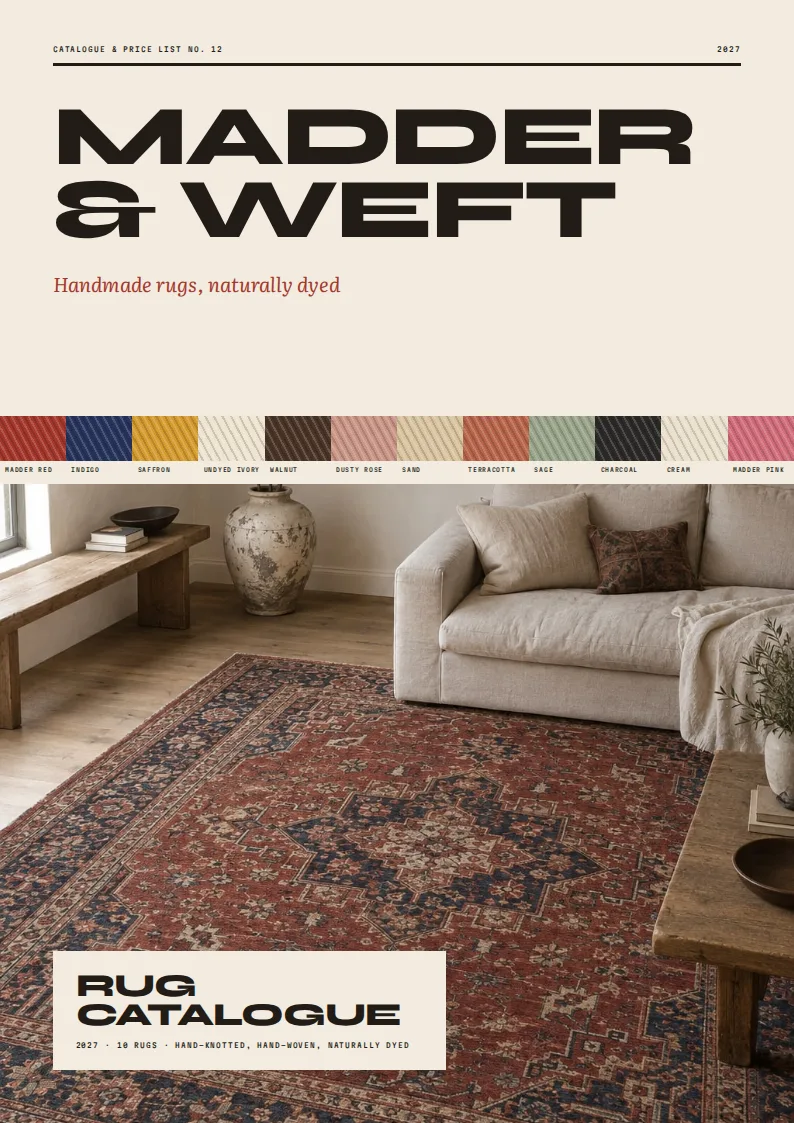
Inside the rug catalog template
Built for artisan rugs catalogs
- A4 portrait layout with cover, contents, and collection openers
- One illustrated page per rug design
- Dye palette, pile detail, and size diagram on product pages
- Size and price tables plus consolidated price pages
- Weaving guide and care guidance
Columns your spreadsheet needs
One row per product. Name your columns like this, or map your own column names when you connect the spreadsheet.
| Column | What goes in it | Example |
|---|---|---|
collection | Collection | Heritage |
collection_note | Collection note | Classical drawings from the weaving towns of western Anatolia. |
image | Product image | HR-101.jpg |
name | Rug name | Uşak Medallion |
sku | SKU | HR-101 |
description | Description | A star medallion based on a nineteenth-century Uşak drawing. |
material | Material | 100% hand-spun Anatolian wool |
technique | Technique | Hand-knotted, Turkish double knot |
origin | Origin | Uşak, Türkiye |
pile_height | Pile height | 10 |
knot_density | Knot density | 120,000 knots/m² |
palette | Color palette | Madder red #A3372B; Indigo #27345C; Saffron #D49A2E |
sizes | Available sizes | 170 × 240; 200 × 300; 250 × 350 |
price_per_size | Price per size | 2890; 4290; 6390 |
designer | Designer or design source | Workshop drawing, 1890s |
An editorial catalog for rug collections
This rug catalog template is for weaving studios, artisan rug brands, and distributors presenting multiple designs in a single document. The A4 portrait layout begins with a cover and introduction, then gives readers a contents page and a guide to rug construction. Each collection has its own photo-led opener before the individual rug pages. The sample catalog renders at 21 pages; your page count depends on the rugs and collections you include.
A collection opener pairs a rug image with the collection name, a short note, and a list of its designs. Use collection to group rugs and collection_note to introduce the shared inspiration or weaving tradition. This gives buyers a way to browse by collection before comparing individual pieces.
Product pages that make details visible
Give each rug its own page with its name, SKU, description, and illustrated details. The layout draws attention to the rug’s pattern, fringe, dye palette, and pile profile. It also presents practical specifications such as material, weaving technique, place of origin, pile height, and knot density where applicable. Add the product photo in image and describe the design in description; the page brings the visual and written details together without reducing the rug to a price-table entry.
The palette can list named colors and hex values, such as Madder red #A3372B. A flatwoven kilim can have a dash for knot density rather than a figure that does not apply. These distinctions help a buyer understand what they are looking at across different constructions.
Sizes and prices buyers can compare
Enter each rug’s available dimensions in sizes and the corresponding values in price_per_size, in the same order. The product page includes a size diagram and a price-per-size table, so a buyer can compare options without searching elsewhere in the document. Separate price pages bring those options together across collections for reference.
The catalog closes with care guidance and a back cover. For a brand that currently assembles collection stories, product specifications, and price lists by hand, the finished PDF puts those pieces into one consistent, print-ready presentation.
Rug Catalog Template, answered
How should I enter sizes and prices?
List available dimensions in `sizes` and their prices in `price_per_size`, separated by semicolons. Keep both lists in the same order so each size has its corresponding price.
Can I include more than one rug collection?
Yes. Use the `collection` column to group designs. Each collection receives an opener, followed by its rug pages.
What appears on an individual rug page?
The page presents the rug’s name, SKU, description, illustrated details, specifications, size diagram, and size-and-price table.
What should I enter for a flatwoven rug with no knot density?
Use a dash in `knot_density`, as the sample does for a kilim. You can still describe its construction in `technique`.
Does the catalog include a separate price reference?
Yes. In addition to the tables on product pages, separate price pages gather rug sizes and prices across collections.
More templates like this

Make your product catalog from your spreadsheet
Start from this template, replace the sample data with your products and export a print-ready PDF.